
Forecast Final Cost (FFC) is your best estimate of total project cost at completion. It combines committed costs with projected costs for remaining work, so you can manage project budgets and make informed financial decisions throughout the project lifecycle.
Before you start
An understanding of contracts, variations, and forecasts in Mastt will provide additional context.
What FFC means
FFC estimates the total cost of your project when complete. It's not just what you've spent so far. It combines your committed costs with your projected costs for all remaining work.
Think of it this way: if someone asked you right now, "What will this project cost when everything is finished?", the FFC is your best answer based on current information.
FFC is crucial because it:
- Helps you understand your project's financial trajectory
- Enables informed decision-making about costs and resources
- Helps you anticipate budgetary needs for your finance team
- Allows you to identify potential overruns early
- Enables you to implement corrective measures in a timely manner
Important: FFC is dynamic and changes throughout the project as contracts, variations, and forecasts are added or updated. It's a calculated field that updates automatically, so you cannot edit FFC directly.
How Mastt calculates FFC
Mastt calculates FFC automatically using this formula:
Forecast Final Cost = Current Contract + Forecast & Uncommitted
When you add Current Contract plus Forecast & Uncommitted, you get a comprehensive view of your total expected expenditure.
| Component | What it represents | What's included |
|---|---|---|
| Current Contract | What's already committed: the money you're definitely going to spend | Approved Contracts: contracts that have been approved and are active Approved Variations: variations that have been fully approved In Principle Variations: variations that have been agreed to in principle |
| Forecast & Uncommitted | What's potentially coming: costs that aren't fully committed yet but are likely or possible | Pending Contracts: contracts that are in process but not yet approved Forecast Variations: estimated variations that haven't been submitted yet Pending Variations: variations that have been submitted but await approval Open Forecasts: any other forecasted costs you've entered for future work, like Contingencies or Risk Provisions |
Where to find FFC
| Page | Where to look | What it shows |
|---|---|---|
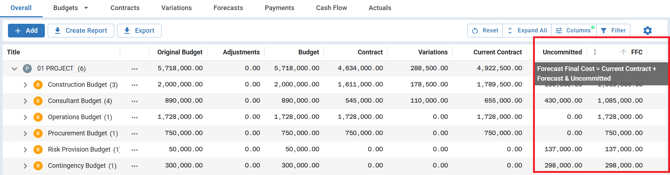
| Cost (Overall page) | The FFC column on the right side of the table | WHAT your FFC is for each budget line |
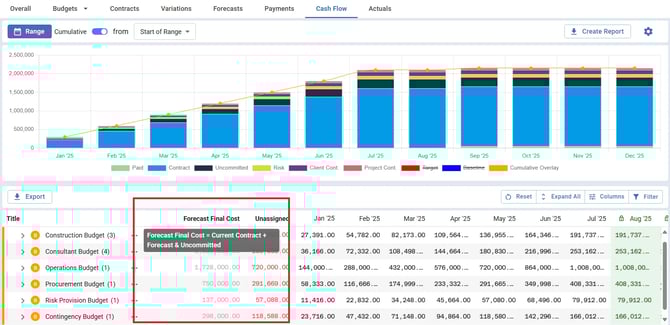
| Cash Flow | The Forecast Final Cost column on the left side of the table | WHEN those forecasted costs will occur |
Find FFC in the Cost module
- Click Cost in the left-hand navigation bar to open your Cost module.
- On the Overall page, where you can see your budget structure, find the FFC column on the right side of the table.
In this view, you can see:
- FFC for your overall project at the top level
- FFC broken down by individual budget lines (Construction Budget, Consultant Budget, Operations Budget, etc.)
Tip: Hover your cursor over the FFC column header to see the formula breakdown.
Find FFC in Cash Flow
- Click Cash Flow in the top navigation bar.
- Find the Forecast Final Cost column on the left side of the table.
- Review the monthly columns across the screen.
In Cash Flow, you can manually enter your forecasted costs across monthly periods. This helps you plan when costs will be incurred and when funds will be needed.
Cash Flow takes your FFC value and shows:
- When costs will be incurred each month
- How to plan for financial needs over time
- When funds must be available to meet obligations
Update FFC
You cannot edit FFC directly because it's a calculated field. To update FFC, you must update the underlying components that feed into the calculation.
Step 1: Identify which component to update
Ask yourself:
| Question | What it affects |
|---|---|
| Do I need to update a Contract amount? | Current Contract |
| Do I need to modify a Variation? | Current Contract or Forecast & Uncommitted, depending on status |
| Do I need to change a Pending Contract? | Forecast & Uncommitted |
| Do I need to adjust a Forecast? | Forecast & Uncommitted |
Step 2: Update the underlying component
The process depends on which component you're updating. FFC recalculates automatically once you save your changes.
| To change a | Go to | What to update | Steps |
|---|---|---|---|
| Variation | The Variations register | The variation amount | How to Edit and Delete Variations |
| Contract | The Contracts register | The contract amount or status | How to Edit and Delete Contracts |
| Forecast | The Forecasts register | The forecast amount | How to Edit and Delete Forecasts |
In each register, locate the item you want to modify, then make your change and save.
Step 3: View the updated FFC
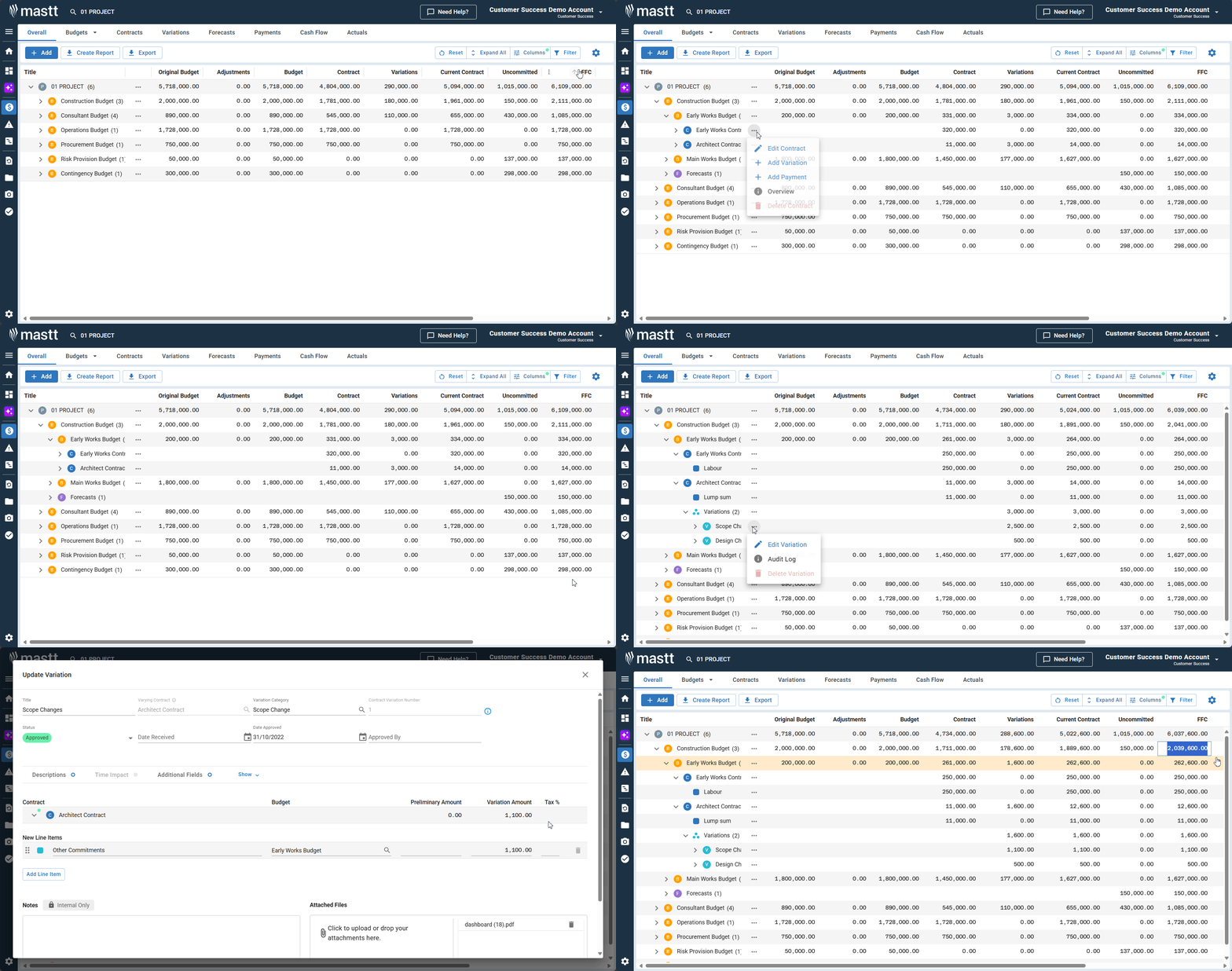
- Click Overall in the top navigation to go back to the Cost module.
- Find the FFC column for the budget line that contains your updated component.
- Check that the FFC has automatically updated to reflect your changes.
The FFC recalculates immediately based on the actual data in your project. You don't have to remember to manually update it. Mastt does it for you.
Use FFC for ongoing project management
Monitor FFC continuously
- Set a regular cadence (weekly or monthly) to review your FFC
- Make it part of your regular project reviews
- Compare your FFC to your original budget to identify variances
Identify trends and issues early
- Compare your FFC to your Budget column to see variances
- Example: If your Budget was $10 million and your FFC is now $10.5 million, you have a $500,000 variance that needs attention
- The earlier you spot trends, the more options you have to address them
Make informed decisions
If FFC shows you're trending over budget, you might:
- Investigate cost-saving opportunities
- Re-prioritise scope
- Request additional budget from stakeholders
- Implement tighter change control processes
Plan cash flow timing
- Click the Cash Flow tab to view FFC distributed across monthly periods.
- Work with your finance team to ensure adequate funding is in place for each period.
- Use the Cash Flow view to optimise fund allocation before costs are due.
Troubleshooting and FAQs
Why can't I edit the FFC value directly?
FFC is a calculated field that updates automatically based on your contracts, variations, and forecasts. To change FFC, update the underlying components rather than editing the FFC value itself.
What if my FFC is higher than my original budget?
Review which components are driving the increase by checking your pending contracts, pending and forecast variations, and open forecasts in the Cost module. This early visibility allows you to investigate cost drivers and take corrective action.
How often does FFC update?
FFC recalculates immediately whenever you add, edit, or approve a contract, variation, or forecast. The value is always current based on your latest project data.
What's the difference between FFC in Cost Overall and Cash Flow?
Cost Overall shows the total FFC amount for each budget line. Cash Flow shows the same FFC amount distributed across monthly periods, helping you plan when funds will be needed.
Need help?
Contact Mastt Support for additional assistance with Forecast Final Cost management.